
how-to
Optimising Fuel Routes for Trucks: A Step-by-Step Guide
14 October 2026 · 12 min read
Table of Contents
- Why Optimising Fuel Routes for Trucks Matters
- What You'll Need Before You Start
- Step 1: Assess Your Current Fleet Fuel Management
- Step 2: Plan Multi-Stop Delivery Routes and Load Sequencing
- Step 3: Reduce Truck Fuel Consumption Through Route Geometry
- Step 4: Use Truck Route Planning Software and Telematics
- Step 5: Track and Measure Truck Fuel Usage Tracking Results
- Common Mistakes to Avoid When Optimising Routes
- Frequently Asked Questions
Last Updated: October 11, 2026
Why Optimising Fuel Routes for Trucks Matters
Fuel costs are one of the biggest operating expenses for truck fleets. Optimising fuel routes for trucks directly cuts your fuel bills, reduces wear on vehicles, and improves delivery schedules. A truck that travels unnecessary miles, idles in traffic, or carries a poorly balanced load wastes fuel, each problem is fixable.
What You'll Need Before You Start
Before you optimise fuel routes for trucks, gather: 12 months of fuel spending by vehicle and location; current route data showing which locations your trucks visit and in what order; vehicle specifications (tank capacity, payload, axle weight limits, height and length restrictions); and fuel-stop locations that accept your payment method and offer discounts.
| Information Needed | Why It Matters | Where to Find It |
|---|---|---|
| 12-month fuel spend by vehicle | Establishes baseline for measuring improvement | Fleet fuel cards, invoices, accounting records |
| Current route data | Shows inefficiencies and backtracking | Dispatch records, GPS logs, driver reports |
| Vehicle specs (tank, weight, dimensions) | Ensures correct vehicle assignment to loads | Vehicle registration, fleet maintenance records |
| Fuel station network | Identifies stops that fit your routes and budget | Payment provider network maps, driver feedback |
Step 1: Assess Your Current Fleet Fuel Management
Start by understanding exactly how much fuel your fleet uses and where the waste occurs.
Pull fuel transaction data for the past 12 months and calculate fuel consumption per vehicle per month. Calculate cost per kilometre for each vehicle by dividing total fuel spend by total kilometres driven. Trucks consuming significantly more fuel than identical vehicles on similar routes are burning money.
Review your current routing method. Most fleets use time-based routing, which often creates inefficient fuel paths. Document where drivers currently refuel, inconsistent fuelling practices hide waste and prevent volume-based discounts.
Step 2: Plan Multi-Stop Delivery Routes and Load Sequencing
Begin by grouping deliveries geographically and sequencing stops logically to reduce unnecessary miles. Optimising fuel routes for trucks requires accounting for truck-specific legal and physical constraints that generic delivery routing ignores.
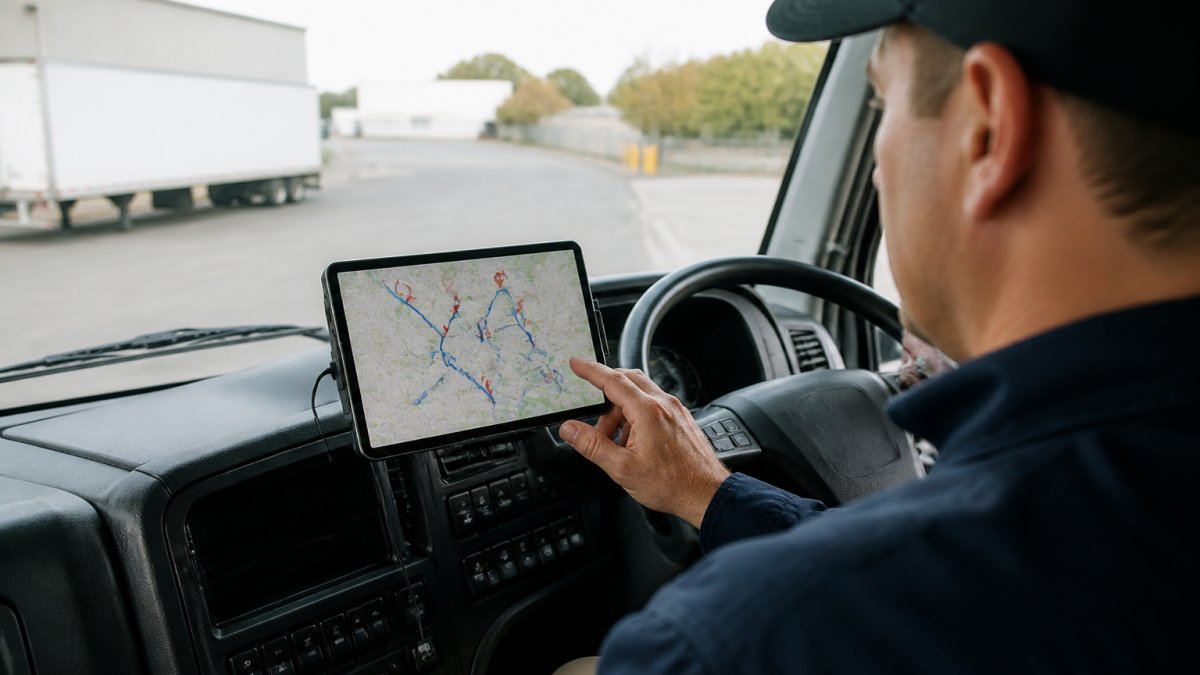
Account for truck-specific routing constraints. Before sequencing stops, verify which vehicles can legally access each location:
- Height and length restrictions. A rigid truck or articulated rig cannot fit under low bridges, through narrow laneways, or into some urban delivery zones. A smaller rigid or van can. Route planning software must know vehicle dimensions and apply them to each stop. Manual routing often ignores this until a driver arrives and cannot proceed.
- Axle weight limits. Different roads have different axle-weight limits. A fully loaded articulated truck may exceed limits on certain regional roads or bridges. Check local council and Main Roads specifications for each route segment. Overloading an axle is illegal and increases fuel consumption.
- Hazardous material routes. If your load contains fuel, chemicals, or other hazmat, certain roads are prohibited. Some routes require permits. Hazmat vehicles must avoid schools, hospitals, and residential areas during certain hours. These constraints are non-negotiable and must be built into route planning before sequencing stops.
- Time-of-day restrictions. Some areas restrict heavy vehicles during peak hours or school times. A route that works at 6 a.m. may be illegal at 8 a.m. Plan stops with these windows in mind.
Sequence stops geometrically to reduce backtracking, but apply truck constraints first: if a stop requires a smaller vehicle, do not assign it to a rigid truck just because the rigid truck is in that area. Match vehicle size to load weight and destination access. Right-sizing vehicles ensures legal compliance and cuts fuel waste. Distribute load weight across axles to stay within legal limits and minimise fuel consumption.
For multi-stop routes, sequence stops so the truck never returns to areas already covered. Software tests thousands of sequences in seconds while checking truck constraints automatically; manual planning creates inefficient paths and illegal assignments.
Step 3: Reduce Truck Fuel Consumption Through Route Geometry
Route geometry has enormous impact on fuel use. Unnecessary miles, backtracking, and roundabout roads all waste fuel. Smooth, direct routes use less fuel than stop-start city driving. Hills and terrain affect consumption; plan routes that avoid major elevation changes where possible. Update routes when construction or traffic patterns change.
Step 4: Use Truck Route Planning Software and Telematics
Route optimisation software generates efficient routes automatically by testing thousands of combinations and accounting for time windows, vehicle capacity, driver hours, and fuel efficiency. The best platforms integrate fuel-stop planning into the route itself, not as an afterthought.
Plan fuel stops as part of route optimisation, not after. A truck with a 300-litre tank and 8-litre-per-100-km consumption can travel roughly 3,750 km on a full tank. On a long-haul route, fuel stops are not optional; they are route waypoints that affect total distance, driver hours, and fuel cost.
Balance three factors when planning fuel stops: tank range and payload (know real-world range under load and plan conservatively); fuel price variation (compare total cost of detours against staying on the direct route); and driver hours and fatigue (plan stops at locations where drivers can rest safely, satisfying Australian Heavy Vehicle National Law requirements).
Designate fuel stops on your planned routes before dispatch. Do not leave it to drivers to choose. Consistency reduces fuel waste from inefficient choices and enables volume-based fuel discounts (which require predictable purchasing patterns).
Telematics systems track real-world driving behaviour. They show idling time, harsh acceleration, speeding, and actual fuel consumption. This data reveals where drivers can improve and which vehicles have mechanical problems. Telematics also confirms whether drivers are following planned routes and stopping at designated fuel locations.
Together, these tools create a feedback loop. Software plans better routes with designated fuel stops. Telematics shows whether drivers are following them and driving efficiently. You adjust and improve.
Look for software that integrates with your existing systems: dispatch, accounting, GPS, and fuel cards. Disconnected tools create manual work and errors. The software should also allow you to input fuel-stop networks (such as major truck-stop chains or bulk-fuel suppliers) so that route optimisation can factor in real fuel prices and availability, not just distance.
Step 5: Track and Measure Truck Fuel Usage Tracking Results
Measurement is where optimising fuel routes for trucks proves its value.
Establish a baseline. Calculate your current fuel consumption per kilometre, per vehicle, and per month. This is your starting point for measuring improvement.
After implementing route changes, track the same metrics month by month. Look for improvement in:
- Fuel consumption per kilometre
- Total fuel spend
- Kilometres driven per delivery
- Idling time
- Driver compliance with planned routes
Set a realistic improvement target. A 5-10% reduction is achievable for most fleets within three months. Some fleets see 15% improvement. Expect results to plateau after that unless you make further changes.
| Metric | Baseline | Target | Measurement Frequency |
|---|---|---|---|
| Fuel per km | Current average | 5-10% reduction | Monthly |
| Total fuel spend | Last 12 months | Proportional reduction | Monthly |
| Km per delivery | Current average | Reduced backtracking | Weekly |
| Idling time | Current baseline | 20-30% reduction | Weekly |
| Route compliance | Current % | 90%+ | Daily |
Track results by vehicle and by driver. Some vehicles will improve more than others. Some drivers will adopt efficient driving faster than others. Use this data to identify which practices work best, then spread them across your fleet.
Document the savings. Calculate how much fuel cost reduction you've achieved. Compare it against the cost of software or consulting. Most fleets recover their investment within six months.
Common Mistakes to Avoid When Optimising Routes
Most fleets make predictable errors when they start optimising fuel routes for trucks. Knowing these mistakes helps you avoid them.
Optimising for time instead of fuel. A fast route is not always a fuel-efficient route. Fast routes often involve motorway driving at high speed, which burns more fuel. Efficient routes favour steady speeds and direct paths. These are different goals. Choose what matters most for your business.
Ignoring load matching. Sending a large truck to pick up a small parcel wastes capacity. Sending a small van to carry a heavy load creates overloading. Match vehicle size to the actual job. This is one of the easiest wins and one of the most overlooked.
Forgetting about driver behaviour. Perfect routes fail if drivers idle excessively, accelerate harshly, or ignore the planned sequence. Train drivers on fuel-efficient driving. Monitor their behaviour with telematics. Reward compliance. Driver behaviour accounts for 10-15% of fuel consumption variation.
Not updating routes regularly. A route that worked in January might not work in July when traffic patterns change. Construction, school holidays, and seasonal traffic all affect efficiency. Review and adjust routes quarterly at minimum.
Underestimating fuel-stop planning. Drivers who refuel at random locations pay inconsistent prices and waste time. Designate fuel stops on planned routes. Use fuel networks that offer discounts.
Optimising fuel routes for trucks is not a one-time project, it's an ongoing process. Start by assessing where you stand now. Plan better routes using software and load-matching principles. Reduce unnecessary miles and idling. Use telematics to track real-world performance. Measure your results month by month.
The businesses that see the biggest fuel savings are those that combine better route planning with volume-based fuel discounts. At FuelPoint, we help Queensland fleet operators access Shell Card volume discounts that can reduce your fuel costs by 6-8 cents per litre compared to pump prices. We review your actual fuel usage to determine if your fleet qualifies, and we manage the transition with zero disruption to your operations. Book a call with FuelPoint to discuss how better routing and fuel card savings can work together for your fleet.
Frequently Asked Questions
How do I plan a fuel-efficient route for a truck?
Start by mapping all stops in logical sequence to eliminate backtracking and unnecessary miles. Account for traffic patterns, road conditions, and vehicle-specific constraints like height and weight limits. Use truck route planning software to calculate the shortest distance and lowest-fuel path, then factor in fuel stops based on tank range and fuel prices along your route. Test the route with telematics data to measure actual fuel consumption before rolling it out across your fleet.
What factors affect fuel consumption on truck routes?
Route geometry, load weight, vehicle matching, driving behaviour, idling time, traffic congestion, and terrain all impact fuel use. Heavier loads require more fuel; inefficient routes with backtracking waste litres per trip. Stop-and-go driving and excessive idling in congested areas spike consumption. Weather, road surface, and payload distribution also play a role. Telematics systems help isolate which factors drive the highest costs on your specific routes.
How can telematics help optimise truck routes?
Telematics provides real-time data on fuel consumption, idle time, driver behaviour, and vehicle performance per route. This data reveals which routes, drivers, or vehicles consume more fuel than expected, allowing you to adjust route geometry, load assignment, or driving practices. You can benchmark routes against a baseline and measure the impact of optimisation changes. Real-time alerts also help prevent fuel waste from excessive idling or harsh braking.
How often should truck routes be reviewed for fuel efficiency?
Review routes quarterly or whenever traffic patterns, job sites, or delivery windows change significantly. After implementing optimisations, measure results for at least one full cycle to account for seasonal variations. Monitor telematics data monthly to catch performance drift and identify new inefficiencies. Construction projects, fuel price changes, and fleet composition updates also warrant route reassessment to maintain fuel savings.
Want this reviewed against your own fuel spend?
FuelPoint is an independent authorised Shell Card sales agent for Viva Energy Australia, serving Queensland businesses. We review your current fuel arrangement and help establish the right Shell Card setup with a zero-hassle transition.
Book a 15-minute fuel spend review